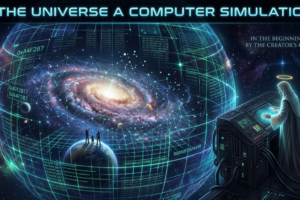

How Can We Understand the Fine-Tuned Universe?
The cosmos is calibrated to a precision that defies all chance. Here’s what the numbers actually say.
Imagine a loaded revolver with a single bullet in six chambers. You pull the trigger against your head. Your odds of survival: 5 in 6. Now picture that same game — but with 10120 chambers, and only one safe outcome. That’s the universe we live in.
This isn’t a dramatic metaphor. It’s the actual mathematics of cosmic fine-tuning — the discovery that our universe’s physical constants sit within a razor-thin range that makes life possible. Shift any one of them by a fraction, and the stars go dark, atoms dissolve, and nothing alive ever forms.
What Is Fine-Tuning?
Since the 1950s, scientists have discovered that for life to be possible anywhere in the universe, multiple physical constants must fall within extraordinarily narrow ranges. This isn’t about whether Earth happens to have liquid water or whether our Sun is stable. This is a deeper question: could life of any kind — anything more organised than scattered atoms — exist anywhere in the cosmos?
The answer appears to be: only if the universe were built almost exactly as it is. And the precision required is staggering.
A Few Numbers That Keep Scientists Up at Night
Fine-tuning isn’t a single curious coincidence. It’s a cascade of them. Consider just four:
And this is just four constants. There are dozens more — each requiring its own improbable precision.
What Scientists Say
The reality of fine-tuning is not seriously disputed. The researchers below run the full spectrum of belief — one is a practising Christian, one was a lifelong atheist, the others somewhere in between. They disagree sharply about what fine-tuning means. They do not disagree that it is there:
Four physicists, four different conclusions, one shared observation

Amazing fine-tuning occurs in the laws that make this possible. Realizing the complexity of the events that have happened, it is hard not to use the word ‘miracle.’

How surprising it is that the laws of nature and the initial conditions of the universe should allow for the existence of beings who could observe it. Life as we know it would be impossible if any one of several physical quantities had slightly different values.

The really amazing thing is not that life on Earth is balanced on a knife-edge, but that the entire universe is balanced on a knife-edge. Even if you dismiss man as a chance accident, the fact remains that the universe is fit for habitation in a way that is self-evidently not ‘reasonable.’

If anyone claims not to be surprised by the special features that the universe has, he is hiding his head in the sand. These special features are surprising and unlikely.

Three Ways to Explain It
When faced with these numbers, science offers only three possible responses:
Chance
We simply got lucky. But with probabilities like 1 in 10120, this isn’t a scientific position — it’s a leap of faith. No other field of science would accept odds this extreme as meaningful evidence of anything. Leonard Susskind, one of the architects of string theory, agrees that blind luck will not do — which is exactly why he argues for a multiverse instead. He has openly conceded that without some such mechanism, defenders of design would be very hard to answer.
Necessity
Perhaps the constants couldn’t have been otherwise — they had to be exactly as they are. But no physicist has produced such a principle. There is no known law that forces the cosmological constant to take the value it has, and Steven Weinberg said as much directly when Richard Dawkins put the suggestion to him in 2006. As far as anyone can currently demonstrate, the constants could have taken other values.
A Creator
No one looks at a spacecraft and assumes it assembled itself by chance. We recognise intelligent design from its hallmarks — precision, purpose, complexity. The fine-tuned universe bears all the same marks. Many scientists and philosophers argue this is not merely a religious conclusion but an inference to the best available explanation — the one left standing when the others have been weighed.
Weighing those three has moved people in both directions — including some who began as committed atheists. The most famous case is Fred Hoyle.
Hoyle was an atheist who disliked the Big Bang so much that he coined the name as a jab at it. In 1953 he worked out that carbon-12 must have an energy level at roughly 7.68 MeV — otherwise stars could not manufacture anything like the amount of carbon we observe. He pushed a Caltech team to look for it. They found it, at 7.68 MeV. Later measurements refined the value to 7.654 MeV, and later work showed the window is brutally narrow: move the strong force by half a percent and the carbon disappears. Reflecting on numbers like these, Hoyle wrote:
It is worth being precise about where Hoyle ended up. He never became a Christian, and he never accepted a personal God. What he argued for was a “superintellect” operating somewhere within nature. But he never went back on the claim that the numbers themselves rule out blind chance — and that claim is the one that matters here.
“But Hasn’t This Been Answered?”
Three objections come up constantly, and they deserve straight answers rather than silence.
“Inflation explains the flatness.” It does — that is precisely what cosmic inflation was invented for. But inflation itself has to be switched on under very particular starting conditions, a point pressed hardest by Roger Penrose and by Paul Steinhardt, one of inflation’s own architects. The tuning moves; it does not vanish.
“Of course we observe a life-permitting universe — we’re here.” True, but it explains the wrong thing. That we survive to observe explains why we see a habitable universe. It does not explain why a habitable universe existed to be observed. A blindfolded firing squad missing every shot is still something you would want an account of, even though you had to survive to ask.
“You can’t assign probabilities to constants at all.” This is the strongest objection of the three, and physicists genuinely disagree about it. It is worked through properly in the Deep Dive.
“For since the creation of the world God’s invisible qualities—his eternal power and divine nature—have been clearly seen, being understood from what has been made, so that people are without excuse.”
Romans 1:20 (NIV)
Want to go deeper?
The Full Case — 7 Constants, the Math, and the Multiverse Problem
The Deep Dive works through every major fine-tuned constant with its sources, examines the multiverse response, and takes on the three strongest objections from working physicists — including the one that says the whole probability argument is malformed.
Read the Deep Dive