Have you ever prayed for something urgent — something not selfish, not sinful, just basic and necessary — and had God stay silent? I have watched more than a few people walk away from their faith for exactly this reason.
A friend of mine prayed for months that his parents wouldn't divorce. They did anyway. Eventually he stopped believing in a God who, in his words, "couldn't even answer a prayer like that." I've watched others walk the same road after losing a close friend to an accident, or after one disappointment too many. If you've been there — or you're there now — this article won't try to talk you out of your pain. I don't have a gift for that kind of comfort. What I want to do instead is show you a bigger picture that sits underneath the pain, one that, understood rightly, might actually give you a reason to lean on God harder in the next crisis rather than walk away from Him.
Why do painful things happen to me?

God did not create a world with suffering and death built in. He created a good world. It was humanity's own rebellion — eating from the one tree God had set apart — that brought the world under a curse, and pain and brokenness came in with it. Scripture is remarkably blunt about how severe that curse becomes when a nation abandons God entirely:
"But it shall come to pass, if thou wilt not hearken unto the voice of the LORD thy God, to observe to do all his commandments and his statutes... that all these curses shall come upon thee, and overtake thee... And thou shalt eat the fruit of thine own body, the flesh of thy sons and of thy daughters, which the LORD thy God hath given thee, in the siege, and in the straitness, wherewith thine enemies shall distress thee." Deuteronomy 28:15, 45, 53 (KJV)
History confirms this happened, more than once. But the cause was never God's design — it was human sin. My sorrow, and yours, exists because everyone on this earth, myself included, has broken God's commands. It is not that God filled the world with grief; it's that we did.
The world is sad because we disobey — not because of God
If people had simply obeyed the commands not to kidnap and not to kill, no child would ever be abducted and murdered. If the wealthy obeyed the command to share what they have with the poor and to care for their brothers and sisters, no one would starve or suffer in poverty.
Why does divorce happen at all? Two people, shaped by decades of different environments and different ways of thinking, are asked to become one and stay one — that was never going to be simple. And yet marriage is exactly the context in which we're meant to learn to deny ourselves and put someone else first. If every husband loved his wife the way Christ loved the church, and every wife honored her husband the way she'd honor the Lord, divorce would not exist in a single home.
The reason divorce happens as often as it does is not that God failed to intervene. It's that God's commands go unkept. The pain in our lives is not caused by God — it's caused by our own failure to keep His commands. So the claim that suffering and evil in the world prove God doesn't exist, or that He is cruel, isn't actually a reasonable conclusion. It's a claim that ignores where the suffering actually came from.
The trial that falls hardest on believers
So what has God promised us about this cursed world? Has He promised to lift the curse now, on our schedule? He hasn't. If anything, He has told us the opposite — that suffering intensifies as history moves toward its end, and that it falls especially hard on those who follow Him.
"For then shall be great tribulation, such as was not since the beginning of the world to this time, no, nor ever shall be."
"This know also, that in the last days perilous times shall come."
"If any man have an ear, let him hear... here is the patience and the faith of the saints."
God never promised to remove this suffering. He told us plainly that the cost of following Him might be everything — even life itself. And yet many believers, faced with hardship that hasn't even reached that scale, conclude that God must not exist, or isn't worth following, simply because He didn't remove their pain on request.
Much of what we beg God for is no different than a child threatening to disown a parent who won't hand over money — even when the demand, by the world's standards, is entirely reasonable.
A perfectly legitimate request — and Jesus' answer to it
In Luke 12, someone interrupts Jesus mid-sermon with a request that was, by any legal standard, entirely fair. Under the law, when a father died, the eldest son received a double portion and the rest of the estate was divided among the remaining sons. This man's brother had apparently taken the whole inheritance for himself. He had every right to be angry. He almost certainly would have won in court.
Jesus doesn't say, "That's unjust, let me fix it for you." He doesn't even offer sympathy. Instead, He rebukes the man for asking:
"And he said unto them, Take heed, and beware of covetousness: for a man's life consisteth not in the abundance of the things which he possesseth." Luke 12:15 (KJV)
What was Jesus actually focused on in that moment? Not the man's finances — his soul. Right before this exchange, Jesus had been teaching about eternal life and warning His listeners to fear the one who has the authority to cast a soul into hell:
"And I say unto you my friends, Be not afraid of them that kill the body, and after that have no more that they can do. But I will forewarn you whom ye shall fear: Fear him, which after he hath killed hath power to cast into hell; yea, I say unto you, Fear him." Luke 12:4–5 (KJV)
Most of the desperate prayers we pray in our pain are, from our side, completely understandable. But understandable is not the same as central. They are not the prayers Jesus treated as the main point.
The one thing God actually promised us
Scripture exists to point to one person, and to what He accomplished on a cross for the whole of humanity. Why do you think Jesus went to the cross? So that you could be wealthy and comfortable? So that you'd live a long, healthy life? So that every wish you've ever made would come true? None of those was the reason.
Jesus went to the cross for one purpose: to save His people and secure their eternal life.
"But these are written, that ye might believe that Jesus is the Christ, the Son of God; and that believing ye might have life through his name." John 20:31 (KJV)
So why do we resent Him — why do we conclude He doesn't exist, or isn't worth following — the moment He doesn't give us exactly what we asked for? Consider what hell actually is: a place with no trace of God's grace, where the pain is not a single crisis but an eternity of them — parents divorcing every day, a child dying every day, no breath of relief, ever. Walking away from God over an unanswered prayer in this life, and stepping instead into that, is exactly the outcome the enemy of our souls wants for us.
Is eternal life actually the most important thing in your life?
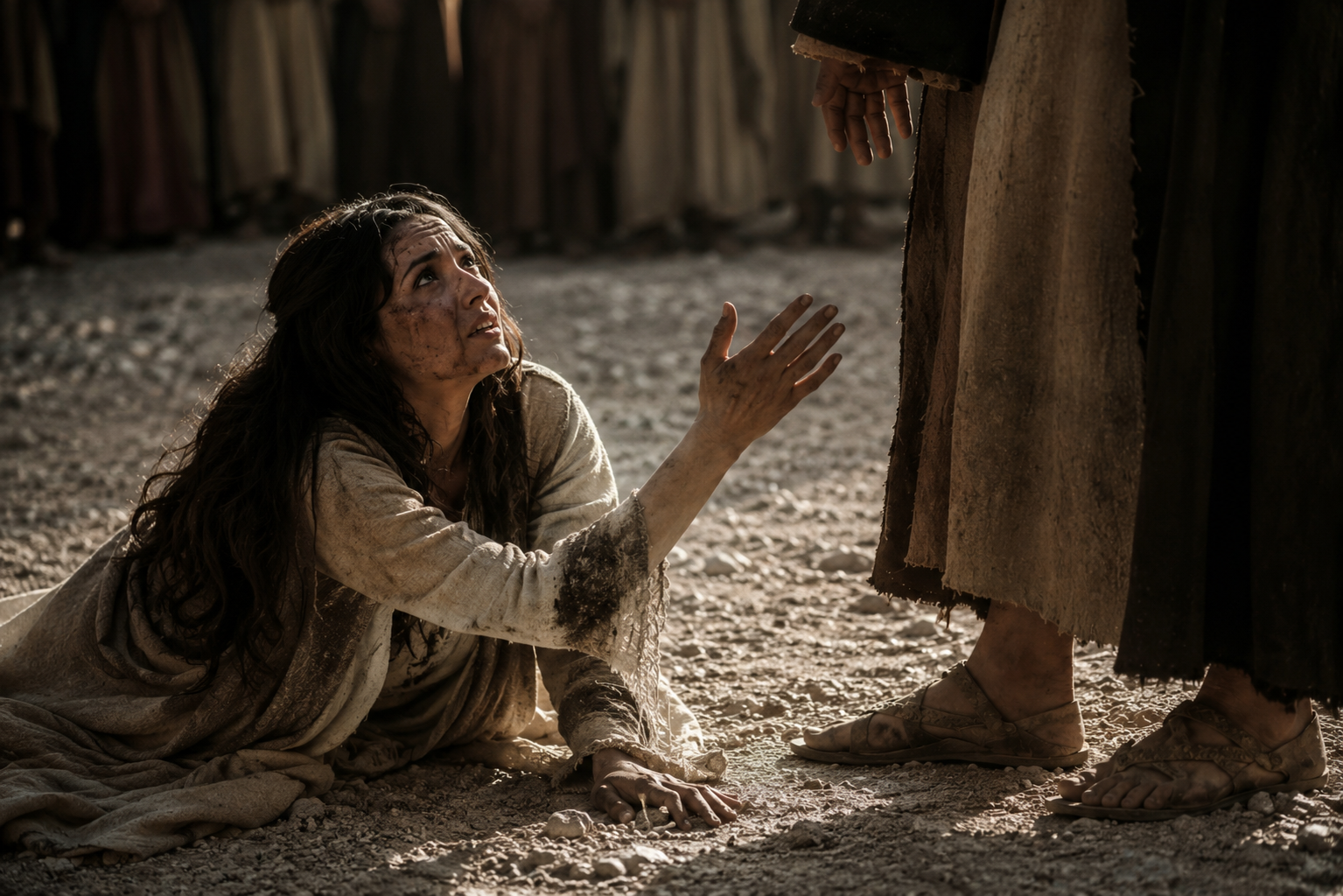
The 1983 film Adam, based on the real abduction and murder of six-year-old Adam Walsh, and the true story his father John Walsh later spent his life fighting to prevent from happening to other families — is the kind of story that has shaped how an entire generation of parents understands fear. And more recently, the 2012 shooting at Sandy Hook Elementary School, in which twenty children lost their lives, became one of the defining tragedies of a generation, one that shook the faith of more than a few grieving parents publicly and permanently.
I can only imagine what that grief actually feels like. If I lost a child, I think I would be undone. Just imagining it is enough to make me shudder.
But here is the question underneath the grief: if we truly believe God's promise, and if we raised that child within the gospel of eternal life, and that child had received Christ — then that child is now in a place with no sorrow, no pain, and no fear, ever again. We will grieve the absence terribly. But the absence is not the whole story. It is not a reason to be angry at God; it's a reason to fix our hope on the God who took people who deserved eternal judgment — that includes us — and is bringing them instead into a kingdom with no more tears.
I've also known someone who lost his closest friend in an accident and walked away from God over it. I sometimes wonder what would have happened if, instead, he had let that loss become the reason he spent the rest of his life telling other people — who have no idea when or how their own life will end — about the gospel before it was too late for them, too.
Why do we so often fail to raise our own children in the faith, fail to bring the gospel to the friends around us — and then, the moment something goes wrong, direct all our anger at God? I think the honest answer is that we don't actually treat eternal life as the most valuable thing God has promised us. We come to God not to surrender our lives to His purposes, but to use Him — to get what we want so we can be comfortable and secure in this world. And that same self-focused instinct, multiplied across all of us, is a significant part of why this world stays as broken as it is.
What is faith, really?
Hebrews 11 is the Bible's own extended definition of faith. Its first half tells the stories of people whose faith conquered kingdoms, obtained promises, and shut the mouths of lions. But at verse 35, the chapter turns, and the turn matters:
"Women received their dead raised to life again: and others were tortured, not accepting deliverance; that they might obtain a better resurrection." Hebrews 11:35 (KJV)
These were people who were offered a way out of their suffering, and refused it — because they were holding out for something better than rescue in this life.
In that account, set during a violent persecution, a king orders each of a mother's seven sons executed in turn for refusing to break God's law. As one of them is dying, he tells the king: it is better to die at human hands while trusting that God will raise him up again — but the king himself has no such hope. Watching each son die, the mother tells them: I did not give you life myself; the Creator of all things, who formed each of you, will mercifully give you life and breath again, since you have set yourselves aside for the sake of His law.
So here is the honest question worth sitting with: is eternal life real to you — real enough that you wouldn't trade your own resurrection for relief from any trial in this life? Do you value it the way God values it?
Who actually owns your life?
God is the Creator and owner of everything that exists — including you and me. We are His creation, His possession. So ask the plain question: does an owner exist for the sake of what he owns, or does what he owns exist for the owner's sake? Does your house exist for you, or do you exist for your house? Obviously — you exist for neither your house, your car, nor your phone. They exist for you.
In the same way, we exist for God, not for ourselves. As our owner, He holds every right over us, and nothing He does with what belongs to Him can be called unjust — not even if He allowed us to suffer for no reason we could name. That was true of Job. God struck Job, and Scripture is explicit: in all of it, God did no wrong.
The real problem isn't God's sovereignty. It's that His possession — us — refuses to obey Him. We live for ourselves, indifferent to what our owner actually wants, treating it as normal to step on other people to get ahead. It's like a car with a driver pressing the brake as hard as they can, and the car simply refusing to slow down.
What we should actually be praying for
And yet God did not abandon the humanity that had turned against Him. He sent His own Son and opened a path to salvation instead. We were headed for permanent ruin; through what Christ accomplished, we've been given the chance to live in permanent joy instead.
So what should that change about how we pray? Perhaps our most urgent prayers shouldn't be for our own circumstances at all, but for the people we love to actually meet God and come to faith in Christ. Perhaps we should be praying, urgently, that God would reveal Christ to our children and our friends — so that they, too, could know real freedom.
That means giving God our lives, not just our requests. Knowing Him more. Meeting Him more deeply. Praying with real urgency — for the right thing.
"My people are destroyed for lack of knowledge: because thou hast rejected knowledge, I will also reject thee... seeing thou hast forgotten the law of thy God, I will also forget thy children." Hosea 4:6 (KJV)
If you're reading this and you've walked away from God over a prayer He didn't answer the way you wanted — I hope this has offered something more than sympathy: a fuller picture of what God actually promised, and why it's still worth trusting Him with everything, including the prayers He hasn't answered yet.
Scripture cited
- Deuteronomy 28:15, 45, 53 (KJV)
- Matthew 24:21 (KJV)
- 2 Timothy 3:1 (KJV)
- Revelation 13:9–10 (KJV)
- Luke 12:4–5, 12:15 (KJV)
- John 20:31 (KJV)
- Hebrews 11:35 (KJV)
- Hosea 4:6 (KJV)
- 2 Maccabees 7:14, 22–23 — historical illustration only; not part of the Protestant biblical canon.
Was this article helpful?
Explore more on suffering, prayer, and the evidence for a living God at W·H·I·T·E.
Browse more articles →