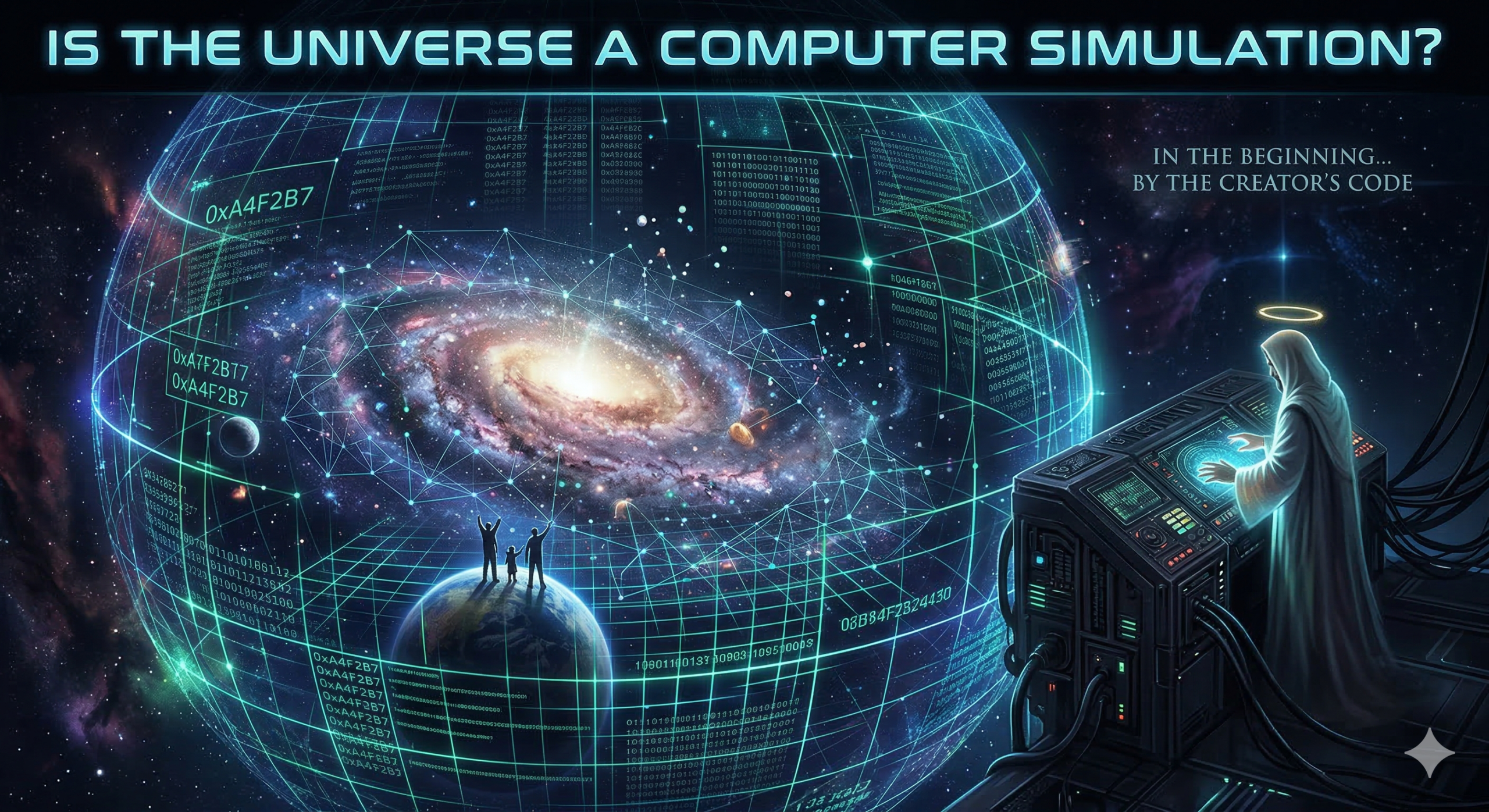
"Are We Living in a Simulated Universe?"
This isn't a line from a science fiction film. It was the official theme of the 2016 Isaac Asimov Memorial Debate at the American Museum of Natural History — moderated by the celebrated astrophysicist Neil deGrasse Tyson, with professors from Harvard and MIT debating the question in complete seriousness.
This was not an isolated episode. The world's most brilliant minds keep returning to the same question.
At the 2009 World Science Festival, Oxford's Nick Bostrom and MIT's Alan Guth — father of cosmic inflation theory — sat together on a panel to discuss whether we might inhabit a simulated cosmos. Nobel Prize-winning astrophysicist George Smoot gave a TED talk on the topic. Peer-reviewed academic papers have been published. On Robert Kuhn's interview program Closer to Truth, the question is posed to scientist after scientist.
If an ordinary person made this claim, people would question their sanity. But these are among the most celebrated intellects in the world. What drives them to such a conclusion? As it turns out, they have their own compelling reasons — and understanding those reasons reveals something profound about the nature of knowledge itself.
The Secret of Mathematics
In 2013, the scientific world erupted with excitement. The Higgs boson — long theorized, long sought — had finally been confirmed in the laboratory. Nicknamed the "God Particle," it is the field-carrying particle that gives matter its mass. The reason it bears Peter Higgs's name? The British theoretical physicist had predicted its existence through mathematics alone — fifty years before the experiment confirmed it.
This pattern is not a coincidence. Throughout the history of physics, mathematicians derive equations and predict the existence of phenomena — then decades later, physicists confirm those predictions with instruments that didn't exist when the equations were written. The mathematics comes first; reality follows.
The universe appears to be written in the language of mathematics. But why?
Nobel laureate Sir Paul Nurse put the question directly to his fellow panelists at the World Science Festival: "How and why can the world be described by mathematics?" He called this the "unreasonable effectiveness of mathematics" — a phrase originally coined by physicist Eugene Wigner — and admitted he found it deeply puzzling.
This observation is not new. Galileo Galilei, the father of modern science, expressed it four hundred years ago with characteristic clarity:
"Mathematics is the language with which God has written the universe."
— Galileo GalileiThis is not poetic flourish. That the world has a precise mathematical structure is a foundational assumption of modern physics — acknowledged in countless documentaries, textbooks, and academic papers. The mystery is not whether it's true, but why it is true.
Two Possible Answers
Why does mathematics describe reality so perfectly? Here, theists and atheists diverge sharply.
William Lane Craig — Christian Apologist
Craig presents the applicability of mathematics as one of his arguments for God's existence. He calls mathematics the "Language of Nature" and argues that the most rational explanation is straightforward: an intelligent Creator designed the universe using mathematics as His medium. Just as an engineer's blueprint reflects the structure of what is built, mathematics reflects the structure of what God built.
What does the atheist position offer? At the World Science Festival, cognitive scientist Marvin Minsky — acknowledging that his answer was strange even to himself — said this:
"If the world were not built on a mathematical structure, DNA could not have formed, and we wouldn't be here to discuss it. So there is no need to answer the question."
— Marvin Minsky, World Science FestivalA Creator designed the world mathematically — therefore it is mathematically intelligible. The cause is explained.
"We couldn't exist without it, so we needn't ask why it's true." The question is evaded, not answered.
Minsky's response is not an explanation — it is a deflection. "We exist, therefore accept it" is not an answer to why. Parallel to the fine-tuning argument, the honest accounting of options leaves us with exactly two:
The Two Conclusions
- A Creator designed the universe mathematically — and mathematics therefore describes it
- Infinite multiverses exist, and ours happened by chance to be governed by precise mathematical laws
The Atheist's Creator: The Simulation Hypothesis
But the infinite multiverse explanation has begun to feel increasingly unsatisfactory — even to many atheists. The coincidences it must explain away are simply too extreme. And so a startling new hypothesis has entered serious scientific discourse:
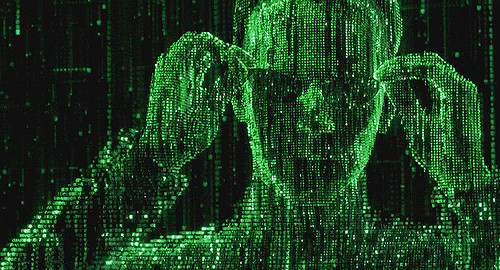
We do not live in actual physical reality. Like Neo in The Matrix, we inhabit a computer simulation. The argument goes like this: "It is far easier to create a simulated universe inside a computer than for this vast, precise universe to actually exist. Therefore, everything you see, touch, and feel may not be real."
Paradoxically, atheists have found themselves invoking a creator — just not a divine one. They propose instead a highly advanced civilization running simulations of universes.
Nick Bostrom (Oxford) · Max Tegmark (MIT)
Professors at two of the world's most prestigious universities argue earnestly for the simulation hypothesis. While the majority of scientists remain skeptical, the fact that these figures advocate for it — and that it has been formally debated at the Asimov Memorial Debate, the World Science Festival, and featured in TED talks — reveals how far mainstream science has traveled in its attempts to avoid a Creator.
James Gates Jr. — Theoretical Physicist, University of Maryland
Gates claims that while studying the equations of Supersymmetry theory, he discovered something extraordinary embedded within them: mathematical structures identical to error-correcting codes used in computer systems. The very equations that describe physical reality appear to contain the same logic as computer code. This claim has become a touchstone for simulation hypothesis advocates, though it remains hotly debated.
To be clear: the simulation hypothesis is not mainstream science. But when it is discussed at major scientific forums by faculty from Oxford and MIT, something significant is being revealed — not about the nature of reality, but about the lengths to which brilliant minds will go to avoid the most obvious alternative.
The Boltzmann Brain: Are We Just a Dream?
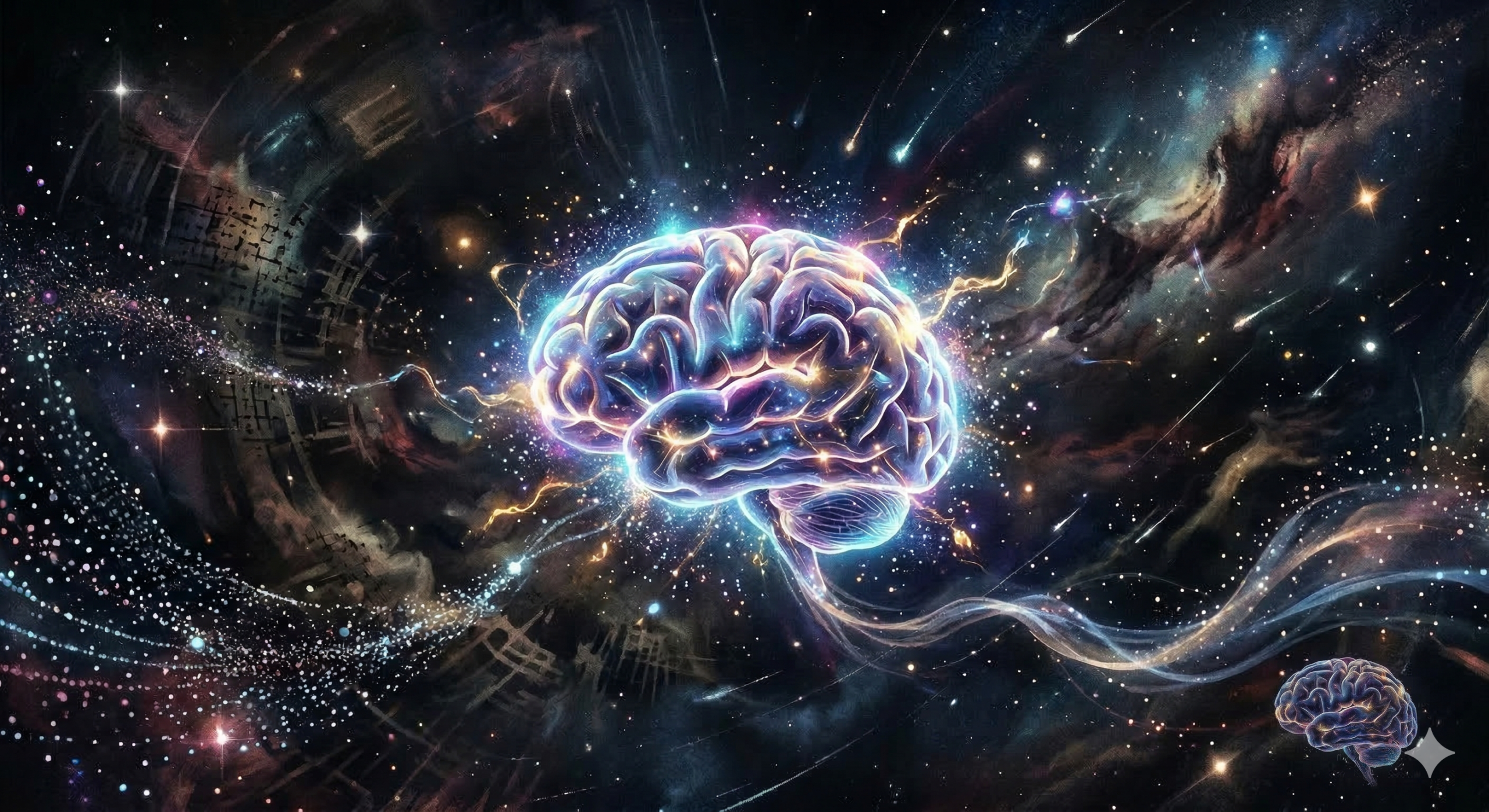
The probability of a lone brain hallucinating an orderly universe is infinitely higher than the probability of such a universe actually existing.
The simulation hypothesis is not the only scientific theory claiming that reality isn't real. Within physics itself, an even more unsettling paradox has emerged.
The Eternal Inflation Model
Alan Guth's original inflation theory has evolved into the Eternal Inflation model. Once inflation begins, there is no theoretical reason for it to stop — so the universe inflates forever, continuously spawning infinite "bubble universes." Atheist cosmologists have embraced this model as a way to explain away fine-tuning, the applicability of mathematics, and even the statistical near-impossibility of life's origins. "With infinite universes," the argument goes, "any configuration will eventually appear."
The Fatal Problem
Here the multiverse theory runs into a catastrophic problem. The laws of probability tell us something deeply disturbing: a random quantum fluctuation is infinitely more likely to produce a single isolated brain that imagines an orderly universe than to produce an actual orderly universe.
Creating a universe takes an enormous amount of organized complexity. Creating one brain — capable of hallucinating such a universe — takes far less. Therefore, if an infinite multiverse truly exists, we are almost certainly not real people in a real cosmos. We are Boltzmann Brains: lone consciousnesses that flickered momentarily into existence from random chaos, experiencing nothing but a hallucination.
Your screen, your memories of childhood, the faces of everyone you love — if the multiverse is real, these are almost certainly the fleeting hallucinations of a brain floating in a void.
"A typical observer in the multiverse is a Boltzmann Brain. The probability that an observer is a Boltzmann Brain is infinitely higher than the probability of being a regular human like us."
— Academic paper on Boltzmann Brains [12]
"The most likely fluctuation consistent with everything you know is that your brain briefly fluctuated out of chaos, and will return to chaos. We call this the Boltzmann Brain Paradox."
— Academic paper on Boltzmann Brains [13]
This is not a fringe thought experiment. The Boltzmann Brain paradox undermines the very foundations of modern cosmology, including the Big Bang theory itself. Many scientists have attempted theoretical solutions; all have been found wanting. Each proposed escape route creates new problems that are just as severe.
Are we truly expected to believe that our world is an illusion?
The One Answer That Resolves Everything
Let us take stock of where atheistic reasoning has led:
- Why is the universe mathematical? — No answer is given
- The Simulation Hypothesis — reality itself is denied
- The Boltzmann Brain Paradox — our very existence as real beings is denied
- Cosmic fine-tuning — cannot be explained by chance alone
- The origin of life — statistically impossible without guidance
Solving every one of these paradoxes is remarkably simple: acknowledge that there is a Creator.
If this world was not assembled by chance but crafted by an Intelligent Designer, every single paradox dissolves. Mathematics describes reality because the Creator used mathematics to design it. The universe is finely tuned because the Creator tuned it intentionally. These problems are not obstacles to faith — they are evidence for it.
"The fool hath said in his heart, There is no God. They are corrupt, they have done abominable works, there is none that doeth good."
Psalm 14:1At some point in history, humanity began using reason as a tool to deny God. The supernatural was excluded from science by assumption — not by evidence. And from that single premise — there is no God — a cascade of absurdities has followed:
The Cascade of Denial
- The world is too precisely ordered → perhaps it is a computer simulation
- Its mathematical structure cannot be explained → perhaps we are Boltzmann Brains
- In rejecting God through knowledge → they end up rejecting reality itself
By denying God in the name of reason, they have arrived at denying reason itself.
"Professing themselves to be wise, they became fools."
Romans 1:22There is only one way for the most brilliant minds on earth to escape these foolish conclusions: acknowledge the God who created this world, and admit our ignorance before His omniscience. In other words — fear the Lord.
"The fear of the Lord is the beginning of knowledge: but fools despise wisdom and instruction."
Proverbs 1:7The fear of the Lord is where genuine knowledge begins. Not as a retreat from inquiry, but as its foundation. Every paradox explored in this article collapses the moment that foundation is restored.
References
- "Is the Universe a Simulation?" 2016 Isaac Asimov Memorial Debate, American Museum of Natural History. Moderated by Neil deGrasse Tyson.
- World Science Festival 2009, panel discussion on the simulation universe. Panelists include Nick Bostrom (Oxford) and Alan Guth (MIT).
- George Smoot, "You are a Simulation & Physics Can Prove It," TEDx Talk, 2013.
- Bostrom, N. "Are You Living in a Computer Simulation?" Philosophical Quarterly, 53(211):243–255, 2003.
- World Science Festival panel discussion on mathematics and reality. Panelists include Paul Nurse and Marvin Minsky.
- William Lane Craig, debate on the applicability of mathematics as an argument for God's existence.
- Various news articles and documentaries on the mathematical structure of the universe [source to be inserted].
- Wigner, E. "The Unreasonable Effectiveness of Mathematics in the Natural Sciences." Communications in Pure and Applied Mathematics, 1960.
- Related news articles [source to be inserted].
- Gates, S.J. Jr. "Symbols of Power." Physics World, 2010. On error-correcting codes in supersymmetry equations.
- Papers on the multiverse and fine-tuning [source to be inserted].
- Academic paper on Boltzmann Brains — typical observer in the multiverse [source to be inserted].
- Academic paper on Boltzmann Brains — most likely fluctuation [source to be inserted].
- Paper proposing a theoretical resolution to the Boltzmann Brain paradox [source to be inserted].
- Paper identifying problems with proposed Boltzmann Brain solutions [source to be inserted].
- Related documentary [source to be inserted].