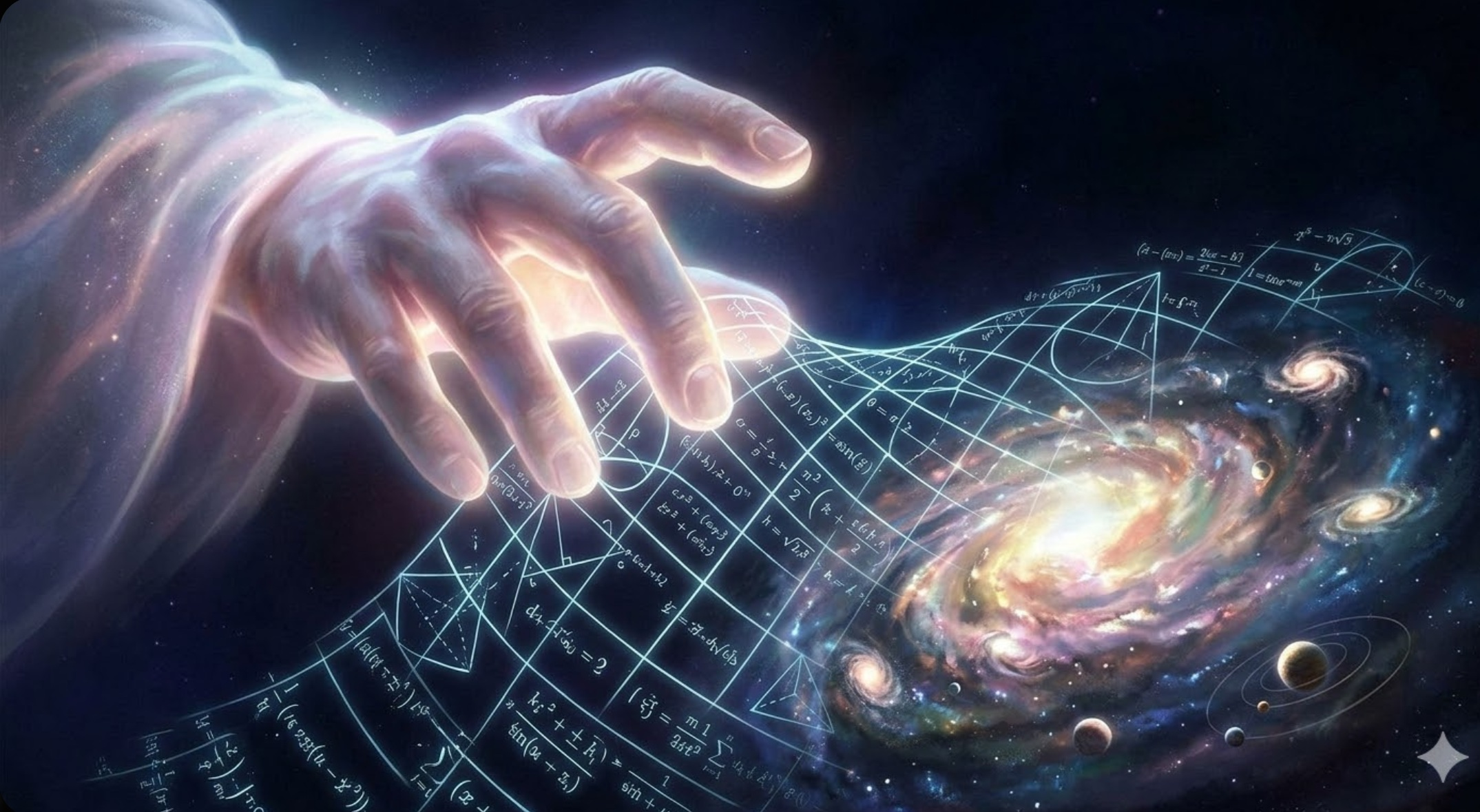
The Question Behind the Question
When someone says, "The universe is ordered because of gravity," they've answered a question nobody asked—and quietly skipped the one that matters most.
Yes, gravity explains why planets orbit in predictable ellipses. But where did gravity come from? Why does it follow a precise inverse-square law—not an inverse-cube, not something approximating a square? Why does any law exist at all, rather than pure chaos?
Consider a parallel. Think about how GPS navigation works. You miss a turn, and within seconds your phone recalculates a completely new route—accounting for traffic, road closures, and your exact speed. Someone asks: "How does the app always find me a new route so instantly?" The response: "Because the software detects your GPS coordinates and runs a pathfinding algorithm." That's technically accurate. But it sidesteps the deeper question entirely: Why is there software? Who wrote the pathfinding algorithm? Who built the system?
Scientists rightly explain how the universe operates through its laws. But the deeper question—why those particular laws exist, and why they can be described by mathematics at all—is a question science assumes but does not answer.
This is where mathematics enters the picture—and where things get genuinely strange.
Invented or Discovered?
Ask most people whether mathematics was invented or discovered, and many will say invented. This sounds intuitively right. After all, humans invented numerals, notation, symbols. We created calculus. Right?
Theoretical physicist Michio Kaku offers a revealing observation: "Mathematicians pride themselves on the fact that their math is useless. They take great pride in researching things that have no practical application."
The pride comes precisely from the fact that they are doing pure exploration—investigating abstract structures that seem to have no foothold in physical reality. And yet, again and again, those "useless" abstractions turn out to describe the universe with shocking precision.
But let's examine the invention claim directly. Consider the number 1.
Five hundred million years ago, a single trilobite swam alone in a Cambrian sea. Long before any human existed, long before any symbol was scratched into stone—how many trilobites were there in that moment?
If mathematics is a human invention, the concept of "one" didn't exist yet. But the trilobite was clearly one. The mathematical reality preceded the human symbol for it by half a billion years.
The Arabic numeral "1," the word "one," the Korean "하나"—these are symbols humans created. But the concept they point to? Scientists are increasingly convinced that mathematical reality is not invented by minds. It is discovered by them.
The question then becomes: when did mathematical truths begin to exist? Scientists say mathematical structures were "true" even before the universe began—in some sense, prior to space, time, and matter. How is this possible for something that was merely invented?
The Mathematician Who Feared His Own Success
Few stories illustrate the strangeness of mathematics better than that of Godfrey Harold Hardy.
Hardy was one of the greatest pure mathematicians of the 20th century. He was also deeply troubled by how mathematics had been weaponized in the World Wars—used to improve artillery, optimize killing. Out of genuine moral revulsion, he made a famous declaration:
"I have never done anything 'useful.' No discovery of mine has meant, or is likely to mean, directly or indirectly, for good or ill, the least difference to the amenity of the world."
— G. H. Hardy, A Mathematician's Apology (1940)Hardy believed he was safe. He was working in the rarefied air of pure number theory—the kind of mathematics that could never, he thought, touch the real world.
He was wrong. Spectacularly wrong.
- The Hardy-Weinberg principle, which he co-developed almost as a side note, became foundational to population genetics—a field that now underlies our understanding of evolution, disease, and hereditary conditions.
- The Hardy-Ramanujan asymptotic formula for integer partitions was applied by physicist Hans Bethe in 1936 to calculate nuclear energy level densities—crucial for understanding atomic nuclei. It was later used to derive thermodynamic functions for non-interacting Bose-Einstein systems.
In the end, Hardy arrived at a confession that reads more like a philosophical concession than a mathematician's boast:
"I believe that mathematical reality lies outside us, that our function is to discover or observe it, and that the theorems which we prove, and which we describe grandiloquently as our creations, are simply our notes of our observations."
— G. H. Hardy, A Mathematician's Apology (1940)Hardy—a committed atheist who desperately wanted his work to be useless—ended up confessing that mathematics exists outside of human minds. It is discovered, not invented. And it keeps reaching into the physical world in ways no one anticipated.
Wigner's Bombshell Paper
In 1960, Nobel Prize–winning physicist Eugene Wigner published what became one of the most cited and discussed papers in the philosophy of science.
Its title: "The Unreasonable Effectiveness of Mathematics in the Natural Sciences."
Wigner's argument was simple but devastating. Mathematicians develop abstract structures for purely aesthetic or logical reasons, with no reference to physical reality. And then, decades or centuries later, physicists discover that those very structures are exactly what they need to describe nature.
This happens too often, and too precisely, to be written off as coincidence. Wigner called it a "miracle" and confessed that he had no rational explanation for it.
Astrophysicist Mario Livio explored this in his book Is God a Mathematician? and concluded that the effectiveness of mathematics is so profound it demands an explanation beyond mere coincidence. Korean scholar Dr. Hwan-seok Park arrives at a similar conclusion in The Creator Discovered in Mathematics.
Einstein himself was so troubled by this that he wrote:
"How can it be that mathematics, being after all a product of human thought which is independent of experience, is so admirably appropriate to the objects of reality?"
— Albert EinsteinEight Predictions That Shocked the World
The most astonishing feature of mathematics is not that it describes what we already know—it's that it predicts what hasn't been seen yet, sometimes decades in advance.
French mathematician Urbain Le Verrier noticed tiny irregularities in Uranus's orbit. Using only Newton's equations, he calculated the exact position of an unseen planet. When astronomers pointed their telescope at his predicted coordinates, Neptune was there—within 1° of his prediction.
1 year laterJames Clerk Maxwell unified electricity and magnetism in four equations. The equations predicted waves traveling at 300,000 km/s—the speed of light. From this, he concluded light is an electromagnetic wave. Heinrich Hertz confirmed electromagnetic waves experimentally 22 years later.
22 years laterBernhard Riemann developed a geometry of curved surfaces through pure imagination—decades before anyone thought space could curve. Einstein discovered Riemann's work and used it to build General Relativity. The universe had been curved all along; a mathematician had described it first.
62 years laterPaul Dirac combined quantum mechanics with special relativity in one equation. His equation had two solutions—one for electrons, and a mathematically necessary "mirror" particle with opposite charge. He predicted it must exist. Carl Anderson discovered the positron four years later.
4 years laterPeter Higgs used mathematics to predict a particle that would give other particles their mass. No experimental evidence existed at the time. The particle was found at CERN's Large Hadron Collider nearly half a century later, exactly as the mathematics described.
48 years laterEinstein's field equations predicted that accelerating masses would ripple spacetime itself. Almost a century passed before LIGO's laser interferometers—sensitive enough to detect a distortion 1/1000th the diameter of a proton—confirmed the waves on September 14, 2015.
99 years laterKarl Schwarzschild solved Einstein's field equations—from a WWI trench—and found a mathematical singularity implying what we now call a black hole. Einstein initially dismissed it as a physical impossibility. Over a century later, the Event Horizon Telescope captured the first image.
103 years laterG. H. Hardy's "purely academic" partition formula (with Ramanujan) was applied by Hans Bethe in 1936 to calculate nuclear energy level densities. Hardy's work he considered safely useless became foundational to nuclear physics and population genetics.
Unexpectedly usefulEach case follows the same astonishing pattern: mathematics developed in isolation, with no connection to physical reality, and then reality catches up—exactly matching the equations. This is not engineering. This is not applying known math. This is pure abstract thought describing physical facts not yet discovered.
Mathematics Woven Into Nature
It's not only physics. Across the biological and natural world, mathematical patterns appear where no one "wrote" them.
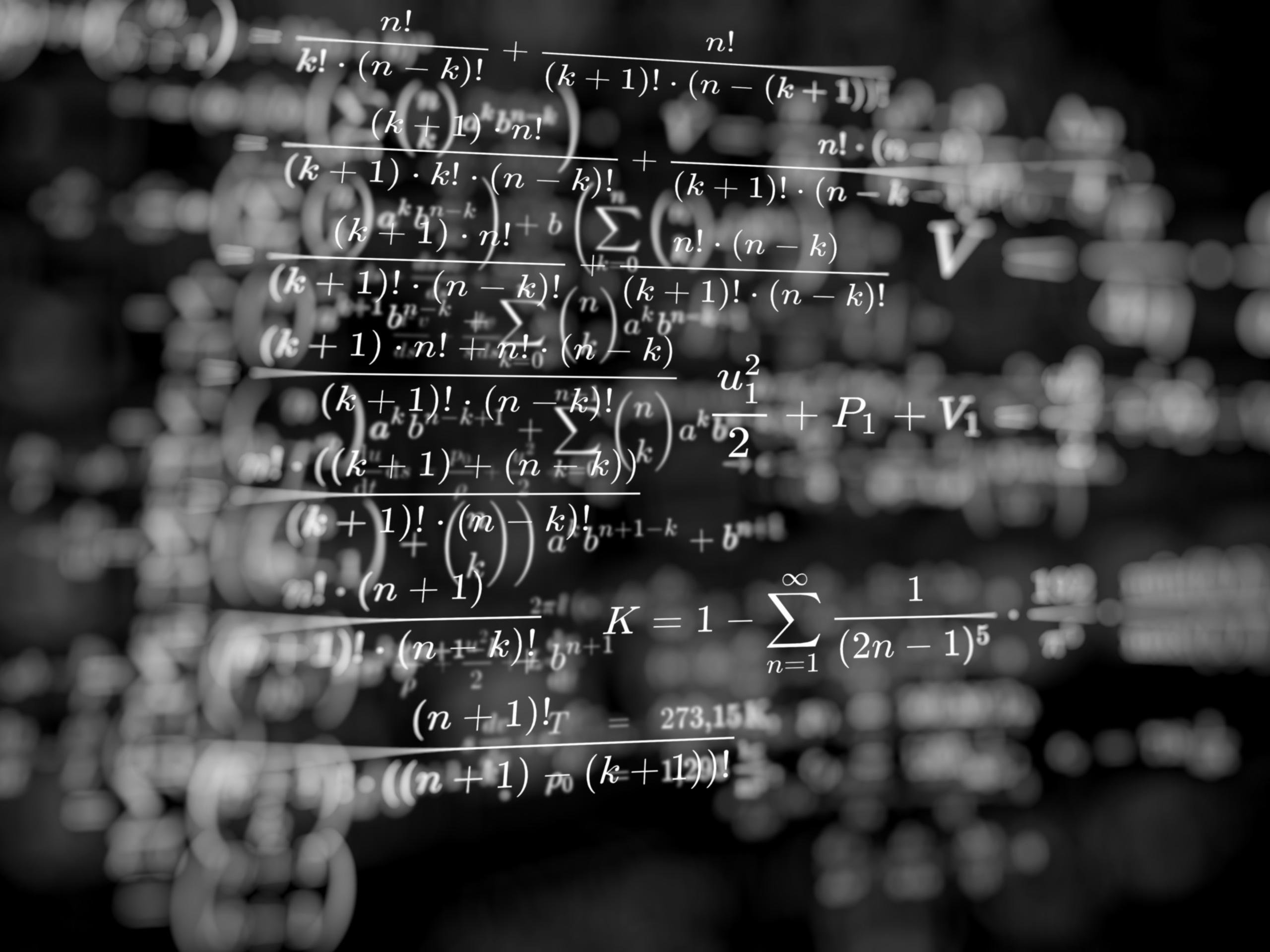
The Fibonacci Sequence
The sequence 1, 1, 2, 3, 5, 8, 13, 21, 34, 55, 89… was studied by medieval mathematician Leonardo of Pisa. It's a simple rule: each number is the sum of the two before it. Nobody designed it for plants.
Sunflowers
Sunflower seed spirals run in Fibonacci numbers—typically 34 spirals one way, 55 the other (or 55/89 in larger varieties). This packing maximizes seed density with no gaps.
Nautilus Shell
The growth chamber proportions follow the golden ratio φ ≈ 1.618, derived from the Fibonacci sequence. Each new chamber is φ times the size of the last.
Pine Cones & Pineapples
Pine cones show 8 spirals in one direction, 13 in the other. Pineapples show 8/13 or 13/21 spirals—all consecutive Fibonacci pairs.
Galaxy Arms
Spiral galaxies follow logarithmic spirals mathematically related to the golden ratio. The same proportion appears from nautilus shells to structures spanning billions of light-years.
The Prime Number Cicadas
Periodical cicadas in North America emerge from underground every 13 or 17 years—both prime numbers. This is not coincidence. Biologists have confirmed that prime-number cycles minimize overlap with predators that have 2-, 3-, 4-, or 5-year cycles.1 The insects "solved" a number theory problem through evolution.
But who embedded prime number theory into biology? A random process? Or something that speaks mathematics?
The Golden Ratio in DNA
The DNA double helix makes one full turn every 34 Ångströms, with a width of 21 Ångströms. The ratio: 34/21 ≈ 1.619—nearly φ. These are consecutive Fibonacci numbers. The molecule of life is built to Fibonacci proportions.
The same mathematical constants appear in subatomic particles, in biological organisms, in planetary orbits, and in galactic structures. There is no physical mechanism that forces these different scales to share the same mathematics. Yet they do.
Euler's Impossible Equation
No discussion of mathematics and reality is complete without the equation that has been called "the most beautiful in all of mathematics."
Five fundamental constants of mathematics—e, i, π, 1, and 0—each discovered independently in completely different areas, combine into a single perfect relationship.
These five numbers come from entirely separate domains:
- e ≈ 2.718 — the base of natural logarithms, discovered in the study of compound interest
- i = √-1 — the "imaginary" number, invented to solve equations with no real solutions
- π ≈ 3.14159 — the ratio of a circle's circumference to its diameter
- 1 — the multiplicative identity
- 0 — the additive identity
None of these were developed together. They come from geometry, algebra, analysis, and number theory—different centuries, different mathematicians, different problems. And yet they form a perfect, irreducibly simple relationship.
Richard Feynman, perhaps the greatest physics communicator of the 20th century, called Euler's identity "the most remarkable formula in mathematics." Physicist David Percy noted that it's precisely this kind of equation—linking disparate mathematical truths in a single statement—that suggests mathematics has a coherence independent of human invention.
The question is not "isn't this clever?" The question is: why does mathematics cohere like this? What guarantees that concepts developed in isolation, for different purposes, will fit together so perfectly?
The Only Two Explanations
Let's be clear about what we've established.
Mathematics was not designed for physics—and yet it describes physics with impossible precision. Mathematical structures developed in abstract isolation turn out, decades later, to perfectly model physical reality. The same mathematical constants appear at every scale of the universe, from DNA to galaxies.
Consider an analogy. Imagine a second-grade student. At that age, a child can barely multiply single digits. Now suppose this child—with no further education, no calculator—instantly solves 10-digit multiplication problems correctly. Then calculus. Then quantum field equations. Every time, perfect.
Would anyone shrug and say "so what"? No. It would be front-page news worldwide. It would be considered a profound mystery demanding an explanation.
Yet the universe—which contains no mathematical knowledge, which emerged (on the atheist account) from an explosion with no intellectual capacity—consistently and precisely embeds the very mathematical structures humans spent millennia developing. The universe solves equations it was never taught.
Option 1: Staggering Coincidence. The universe happens to be built on mathematical foundations, and mathematics happens to describe it, with no underlying reason.
Option 2: A Mathematical Mind. The universe operates mathematically because it was designed by an intelligence that thinks mathematically—a Creator whose reasoning is expressed in the language of mathematics.
Physicist Max Tegmark (MIT) has proposed that the universe is literally a mathematical structure—that physical reality just is mathematics. Even this radical proposal implicitly raises the question: who or what instantiated that particular mathematical structure?
Wigner himself said the unreasonable effectiveness of mathematics is a "miracle"—a word he chose carefully. He had no naturalistic explanation. Many physicists today, including those who are not religious, find the depth of this question genuinely unsettling.
Conclusion
The Language of a Mind
Hardy confessed that mathematics exists outside of human thought. Wigner called its effectiveness a miracle. Einstein asked how it could possibly work. Dirac, Riemann, Le Verrier, Higgs—each watched in astonishment as their abstract equations turned out to describe a universe they had never observed.
The universe is not merely mathematical in some loose, metaphorical sense. It is mathematical at its deepest level—in quantum mechanics, in spacetime geometry, in the structure of DNA, in the behavior of prime numbers among cicadas.
There are two choices. Either the universe—with no mind, no plan, no intelligence—spontaneously generated a mathematical structure of staggering precision and coherence. Or the universe is built on mathematics because it was built by a Being for whom mathematics is not a human discovery but a native language.
For a rational mind, the second option is not faith refusing to follow the evidence. It is reason following the evidence to its most natural conclusion.
References & Further Reading
- Wigner, E. P. (1960). "The Unreasonable Effectiveness of Mathematics in the Natural Sciences." Communications on Pure and Applied Mathematics, 13(1), 1–14.
- Hardy, G. H. (1940). A Mathematician's Apology. Cambridge University Press.
- Livio, M. (2009). Is God a Mathematician? Simon & Schuster.
- 박환석 (Park, H.). 수학에서 발견한 창조주. [The Creator Discovered in Mathematics].
- Bethe, H. A. (1936). "An Attempt to Calculate the Number of Energy Levels of a Heavy Nucleus." Physical Review, 50(4), 332–341. [Application of Hardy-Ramanujan formula to nuclear level density]
- Le Verrier, U. J. J. (1846). Mathematical prediction of Neptune's position. Comptes rendus de l'Académie des sciences.
- Einstein, A. (1916). "Die Grundlage der allgemeinen Relativitätstheorie." Annalen der Physik.
- LIGO Scientific Collaboration (2016). "Observation of Gravitational Waves from a Binary Black Hole Merger." Physical Review Letters, 116(6).
- Higgs, P. W. (1964). "Broken Symmetries and the Masses of Gauge Bosons." Physical Review Letters, 13(16), 508–509.
- Dirac, P. A. M. (1928). "The Quantum Theory of the Electron." Proceedings of the Royal Society A, 117(778), 610–624.
- Yoshimura, M. (1997). "Parasites drive cicada life cycles." Nature. [On prime-number periodicity of cicadas]
- Tegmark, M. (2008). "The Mathematical Universe." Foundations of Physics, 38(2), 101–150.