The Verse That Troubles Everyone
"And if your right hand causes you to sin, cut it off and throw it away. It is better for you to lose one part of your body than for your whole body to go into hell."
Matthew 5:30Somewhere in the history of the Church, people read this verse and actually did it. They cut off their hands. They believed they were following Jesus to the letter.
Most Christians today quietly skip past this passage. They sense something is wrong with the literal reading, but they're not quite sure how to explain it. Was Jesus being hyperbolic? Was He joking? Did He not really mean it?
Here's the answer: Jesus was being completely serious. He meant every word. But what He meant is something far more unsettling — and far more liberating — than either a literal command or a casual metaphor.
To understand it, we have to read all of Matthew 5. Not just the hand and the eye. All of it.
What Jesus Actually Demanded in Matthew 5

Before Jesus mentions hands and eyes, He makes a series of demands. Each one takes a familiar law and tightens it beyond all human expectation:
And sandwiched in the middle of demands 2 and 3 — that's where the hand and eye appear. Jesus isn't giving isolated commands. He's building a cumulative case.
"If your right eye causes you to sin, gouge it out and throw it away… if your right hand causes you to sin, cut it off." — Matthew 5:29–30
Read in context, this is not an instruction for surgery. It's a rhetorical escalation. Jesus is saying: you should be willing to do anything — even something as extreme as cutting off your hand — to avoid sin. But then He immediately makes clear that sin is not just in your hand. It's in your eye. It's in your heart. It's in the angry thought you had this morning. It's in the enemy you've never quite forgiven.
So if you took it literally, you wouldn't just be cutting off one hand. You'd have nothing left.
Be Perfect — He Wasn't Joking
"Be ye therefore perfect, even as your Father which is in heaven is perfect."
Matthew 5:48That's how Matthew 5 ends. Not "do your best." Not "try hard and God will fill in the gap." Be perfect. As God is perfect.
Before He gives these demands, Jesus establishes the ground rules with unmistakable clarity:
"Do not think that I have come to abolish the Law or the Prophets; I have not come to abolish them but to fulfil them. For truly I tell you, until heaven and earth disappear, not the smallest letter, not the least stroke of a pen, will by any means disappear from the Law until everything is accomplished… For I tell you that unless your righteousness surpasses that of the Pharisees and the teachers of the law, you will certainly not enter the kingdom of heaven."
Matthew 5:17–20This is not rhetorical padding. Jesus is setting the terms before He raises the standard. He's saying: the Law is not being relaxed. It is being revealed in full.
And James confirms what this means in practice:
"For whoever keeps the whole law and yet stumbles at just one point is guilty of breaking all of it." — James 2:10
One failure. One flash of lust. One moment of unforgiveness buried so deep you forgot it was there. By God's accounting, that is the same as breaking everything.
The Mirror, Not the To-Do List
Here is the question that should be pressing itself on us by now: if no one can keep this law, why did Jesus give it?
Was it cruelty? Was it ignorance? Did He not understand human nature?
No. Jesus knew human nature better than we know ourselves. He designed us. He was watching humanity in real time for thousands of years before He said a word about the Sermon on the Mount.
The commands of Matthew 5 are not a ladder to climb. They are a mirror to look into.
The mirror shows us something we desperately don't want to see: that our moral self-assessment is broken. Since Adam and Eve, human beings have been deciding for themselves what counts as good and what counts as evil — and we have been consistently generous to ourselves. We grade ourselves on a curve. We compare ourselves to people worse than us. We call ourselves "basically good people."
Matthew 5 is God removing the curve. The standard isn't other humans. It's God Himself.
And once we see the real standard, we should realise: we don't just need our right hand cut off. We need every part of us cut off. We are not basically good people who occasionally slip up. We are people who have been falling short of God's standard every day of our lives — in thought, in emotion, in the things we failed to do, in the forgiveness we never quite gave.
The Pharisee and the Tax Collector

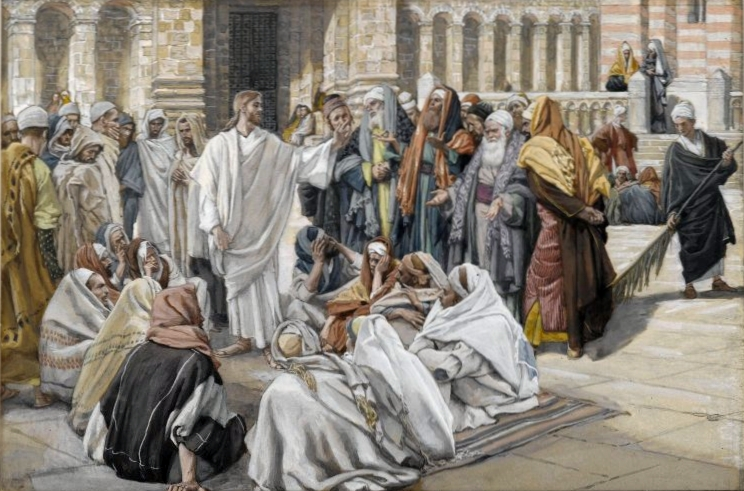
The Pharisees were the most religiously serious people in first-century Judaism. They fasted twice a week. They tithed everything down to the herb garden. They memorised Scripture. They were publicly, visibly, undeniably dedicated to God's law.
And Jesus called them "whitewashed tombs." He told the crowds: unless your righteousness surpasses theirs, you will not enter the kingdom of heaven. If that's the bar, and the Pharisees are failing it, what hope does anyone have?
"God, I thank you that I am not like other people — robbers, evildoers, adulterers… I fast twice a week and give a tenth of all I get." (Luke 18:11–12)
"God, have mercy on me, a sinner." (Luke 18:13)
"I tell you that this man, rather than the other, went home justified before God. For all those who exalt themselves will be humbled, and those who humble themselves will be exalted."
Luke 18:14The Pharisee compared himself to other humans and felt satisfied. The tax collector compared himself to God — and had nothing to say except: mercy.
Notice what Jesus does not say about the tax collector. He doesn't say the man promised to stop his corrupt practices. He doesn't say the man passed a character test. The tax collector brought nothing. He offered nothing. He only acknowledged the truth about himself — and threw himself on God's mercy.
That man went home justified.
There's another figure worth remembering: the criminal crucified next to Jesus. No time to reform. No good deeds to offer. No religious credentials. He simply recognised who Jesus was and said: remember me.
Jesus said: today you will be with me in paradise. No other requirements.
What the Cross Changes
Paul addresses this directly in Galatians:
"Mark my words! I, Paul, tell you that if you let yourselves be circumcised, Christ will be of no value to you at all."
Galatians 5:2Paul isn't condemning circumcision as a cultural practice. He's targeting the logic behind it in this context: the idea that what you do can contribute to your standing before God. If you go that route, he says, you've obligated yourself to keep the whole law — and you've severed yourself from Christ.
The problem with self-justification is not just that it fails. It's that it insults the one who already paid. If I owe a million dollars and someone pays it in full, but I keep trying to add coins to the pile as if my contribution matters — I'm not being humble. I'm being foolish, and I'm implicitly denying that the debt was really paid.
"It is finished." — John 19:30. Not "it is started." Not "your part is still outstanding." Finished.
The logic of the Gospel is not that Jesus helps us reach God's standard. It's that Jesus met God's standard perfectly — on our behalf — and then absorbed the penalty we owed for all the ways we didn't.
Our heart's lust. Our buried grudges. Our smiling resentment. Our self-righteous religious performance. The righteous life we never lived. Jesus lived it. The death we deserved. Jesus died it.
That is not an abstract theology. That is a transaction — and it was completed before you read this sentence.
Conclusion: You Don't Need to Cut Off Your Hand
The Gospel in One Paragraph
God's standard is perfection. No human being has met it. Rather than lower the standard, God sent Jesus to meet it — perfectly — and to receive the punishment our failure deserved. The only thing required of us is to stop pretending we can pay what we owe, and to trust that He already has. That is the Gospel of Jesus Christ.
Jesus didn't tell us to cut off our hands because He wanted amputees in the kingdom. He told us to cut off our hands to show us that cutting off our hands wouldn't be enough.
The problem is not your hand. The problem is deeper than surgery can reach. And the solution is not effort. It is not religious performance. It is not being a good person by the standards of the people around you.
The solution is what the tax collector found. What the thief on the cross found. What every person who has ever honestly stood before God's real standard and said "I have nothing to offer" has found:
"For it is by grace you have been saved, through faith — and this is not from yourselves, it is the gift of God — not by works, so that no one can boast."
Ephesians 2:8–9Don't cut off your hand. Don't gouge out your eye. Someone already bore the weight of what your hand and your eye have done.
Trust that. That is enough. That is everything.
"Come to me, all you who are weary and burdened, and I will give you rest." — Matthew 11:28