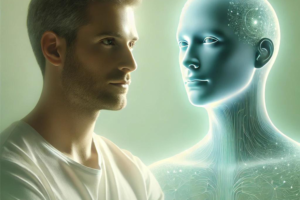

In the realm of modern science and atheistic determinism, a startling proclamation is gaining ground: “Free will is an illusion.” Prominent figures like Sam Harris argue that human beings are nothing more than “biological puppets,” dancing to the tune of physical laws and chemical reactions.
But are we truly just pre-programmed biological machines, or is there something more to the human experience? Let’s dive into the logic behind these claims and why the “death of free will” might be greatly exaggerated.
1. The 0.5-Second Gap: Libet’s Famous Experiment
The “smoking gun” for those who deny free will is often an experiment conducted by Benjamin Libet in the 1980s.
- The Finding: Libet discovered that a specific brain signal (known as the “Readiness Potential”) occurs about 0.3 to 0.5 seconds before a person consciously decides to move their finger.
- The Conclusion (by Determinists): They argue that since the brain starts the process before the mind is even aware of it, the “choice” is just an afterthought—a trick played by the brain to make us feel in control.
2. The Scientific Rebuttal: The Power of the “Free Won’t”
However, this interpretation ignores a crucial part of Libet’s own findings. Libet himself did not believe his experiment disproved free will. He observed that even after the brain prepares for an action, the conscious mind retains the power to veto that action in the final milliseconds.

In the English-speaking scientific community, this is often called “Free Won’t.” While our biology might suggest a path, our conscious mind holds the final “signing authority” to approve or reject that impulse. Preparation is not the same as a final command.
3. The Dangerous World Without Choice
If we accept that free will is non-existent, the pillars of our society begin to crumble:
- The Collapse of Morality: If a criminal is merely a “meat computer” following a program, can we truly hold them responsible? If there is no choice, there is no guilt, and if there is no guilt, the entire concept of justice becomes meaningless.
- The Death of Reason: Scientist J.B.S. Haldane famously noted a logical paradox: If my thoughts are merely the result of chemical reactions in my brain, then my belief that “determinism is true” is also just a chemical reaction. Why should I trust a chemical reaction to tell me the truth? Materialism, in denying free will, accidentally denies the validity of its own logic.
4. More Than Just “Meat Computers”
Reducing the human experience to mere matter and motion ignores the profound reality of our existence. We deliberate, we sacrifice, and we often act against our basic biological instincts for the sake of higher values.

Free will is not a “glitch” in our neural wiring; it is the very foundation of human dignity, love, and responsibility. We are not just spectators watching a movie of our lives; we are the directors.
Curious for more? Let’s dive deep with the button below!