Before we present the evidence in earnest, we must first be able to see our reality. And what that reality is comes down to this: we need to clarify what it means to know something.
You probably think you know many facts.
For example, you know who your parents are, you know where your home is. And you know, as a matter of complete obviousness, that you are a person — and that people typically have two eyes, one nose, one mouth, and ten fingers.
But is that truly knowing?
If we apply a genuinely rigorous definition of “knowing,” there are almost no facts we can claim to truly know.
In the movie The Matrix, the protagonist Neo lives in what he believes to be reality, working as a programmer. But after taking the red pill that reveals the truth, he discovers that the world he had been living in was actually a virtual reality, and that a separate, real world exists.

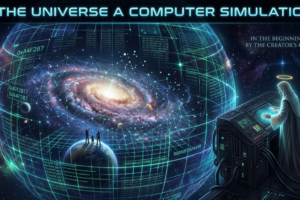
Can you prove that this world is a real, physical reality and not a virtual simulation inside a computer program?
Likewise, in the movie Inception, the protagonist Cobb crosses back and forth between reality and dreams using a dream machine, and we see people who cannot distinguish between dreams and reality — or who cannot escape from them.
Can you be certain that right now, as you read this book, you are living in the real world and not a dream?
You might think I am being unreasonable, but this is an extraordinarily well-known topic among philosophers.
We will explore it in more detail in the next chapter, but scientists actually research, hold seminars, and write papers on the possibility that this world is a virtual reality.
Furthermore, in attempting to solve the problem of the multiverse — a topic we will address later — what was discovered is that the probability of this world being an illusion created by a brain floating somewhere in space is infinitely greater than the probability of this world actually existing.
Of course, I myself am convinced that the world we live in is real and physical. But my conviction does not make it fact.
In that sense, I believe that what I see exists — I do not know it. Because I cannot prove that what I perceive is not an illusion fabricated by my brain, or an impossibly vivid dream.
Therefore, just as believing that God is alive is a matter of faith — since I have never seen Him with my own eyes — believing that my friends, my parents, and my teachers are real is equally a matter of faith. Indeed, even the fact that I have eyes at all is something I cannot prove; it too is belief.
So there is only one thing we can know without requiring any faith whatsoever.
That is the fact that there exists a “self” — a being capable of thinking about whether or not it exists.
Not the human “I” with two eyes, a nose, a mouth, and ten fingers — but the “I” that can wonder and think, whether it is a brain floating in some unknown space, or a soul existing not in any physical space but in a spiritual realm.
And so the philosopher René Descartes, who set out to negate everything that could possibly be negated, discovered the one thing he could never deny, and left us these famous words:
“I think, therefore I am.”
Many people respond to this problem by saying they are agnostic. But if one truly cannot rationally know whether God exists, then one must also say that we cannot know whether this world is a real, physical space-time. That is what genuine rational thinking, free from all presuppositions, actually demands.
Apologetics is a discipline that already begins from the assumption that all things are, at some level, unknowable. This is precisely why agnosticism cannot stand between the debate of atheism and theism. We simply assume the world of theism or the world of atheism, and proceed from there — determining which is more rational and reasonable given what we understand about the world.
As you read this book, you cannot take the position of “I don’t know whether God exists or not.” You need only decide: in a hypothetical world where God exists, or in one where He does not, which version of reality makes more rational and coherent sense to you — and then determine whether that world aligns with how you understand things to be.